
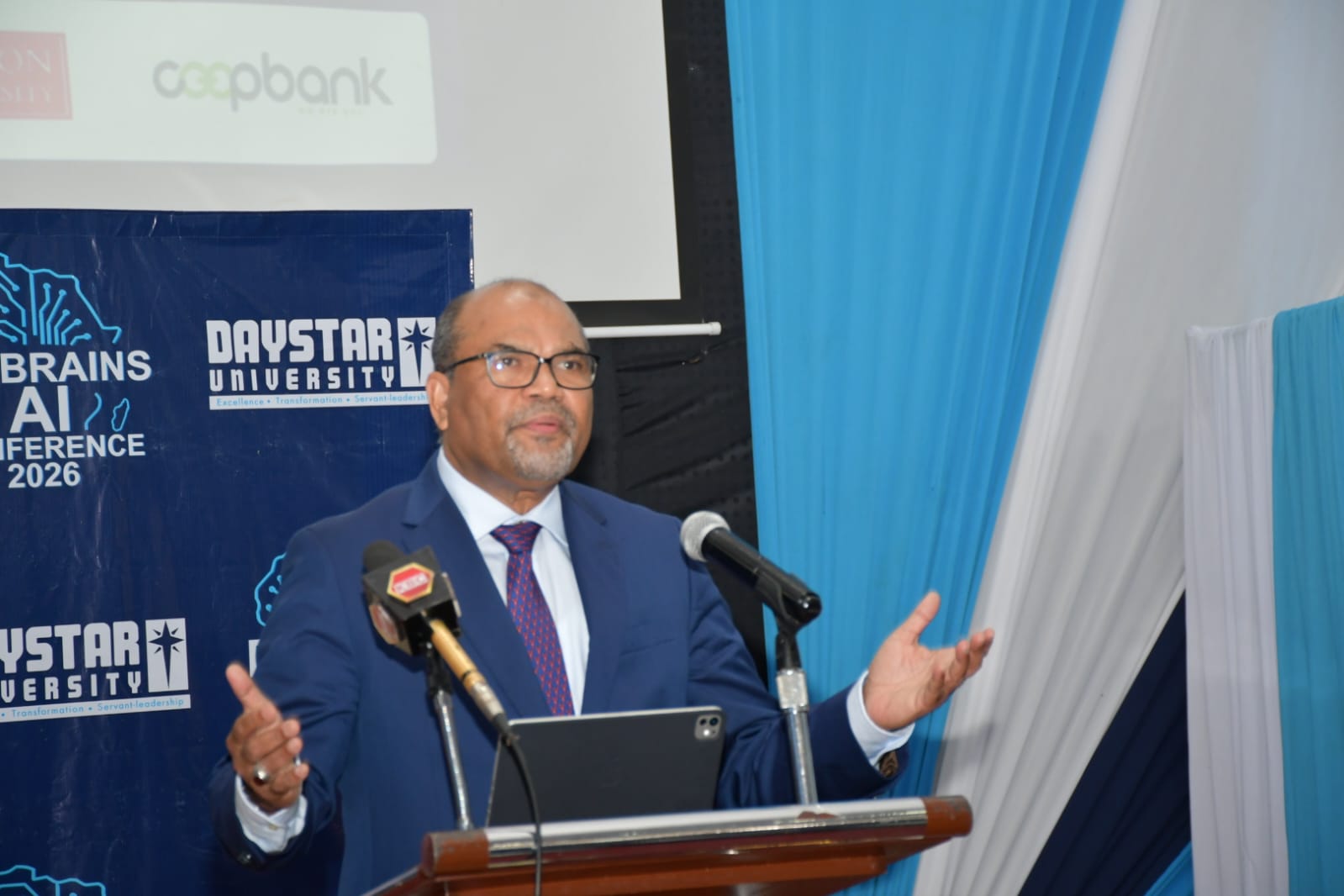
Prof. Shaukat Abdulrazak Calls for Responsible AI to Drive Inclusive Development at Daystar University's DU-BRAINS 2026 Conference
Prof. Shaukat Abdulrazak Calls for Responsible AI to Drive Inclusive Development at Daystar University's DU-BRAINS 2026 Conference
Nairobi, Kenya
– Principal Secretary for the State Department for Science, Research and Innovation, Prof. Shaukat Abdulrazak, EBS, has called for a values-driven approach to artificial intelligence, urging researchers, universities, industry and policymakers to ensure that AI advances human dignity, promotes inclusion and delivers practical solutions to Kenya's development challenges.
Speaking during the Daystar University DU-BRAINS 2026 Conference, held under the theme "Building Responsible Artificial Intelligence for Inclusive Networked Societies," Prof. Abdulrazak said AI must be developed and deployed responsibly, with ethics, accountability and inclusivity at its core.
The Principal Secretary emphasized that while AI presents unprecedented opportunities to transform sectors such as agriculture, healthcare, education and public service, it must always remain centred on people.
"The question before us is not simply how to develop artificial intelligence, but how to harness it to expand human opportunity without diminishing human dignity," he said.
Prof. Abdulrazak noted that responsible AI requires strong ethical foundations and should be guided by transparency, accountability and fairness.
He challenged researchers to continually ask whose problems AI is solving, whose data is being used, who benefits from the technology and who remains accountable when AI systems fail.
The PS reiterated the Government's commitment to strengthening Kenya's research and innovation ecosystem through greater collaboration among universities, research institutions, industry and government agencies.
He outlined the State Department's vision of establishing thematic research and innovation clusters, where institutions specialize in their areas of comparative advantage while working collaboratively to address national priorities.
He said the proposed clusters would focus on strategic sectors such as the bioeconomy, energy, digital technologies, robotics, cybersecurity, digital health, climate intelligence and smart agriculture, with artificial intelligence serving as a key enabler for research collaboration and innovation.
Prof. Abdulrazak also called for a shift in research funding from isolated projects towards multidisciplinary and multi-institutional programmes focused on solving major national challenges. He challenged the National Research Fund and other research agencies to prioritize collaborative research capable of delivering measurable societal impact.
Highlighting Africa's relatively small contribution to global scientific knowledge, he underscored the need to strengthen the country's research capacity by increasing the number of highly skilled researchers and investing more in science, technology and innovation.
The Principal Secretary reaffirmed the Government's commitment to progressively increase investment in research and development in line with the Science, Technology and Innovation Act, while strengthening commercialization pathways that transform research into products, enterprises, jobs and economic growth.
Prof. Abdulrazak further encouraged universities to move beyond measuring success solely through publications, urging institutions to place greater emphasis on innovation, commercialization and real-world impact.
Drawing from a recent visit to the Kenya Primate Research Institute (KIPRE), he cited locally produced antivenom as an example of how research should directly respond to societal needs, noting that Kenya has the scientific capacity to develop life-saving solutions capable of serving both the region and the continent.
He challenged researchers to focus on pressing national questions, including reducing maternal and infant mortality, improving disease surveillance, enhancing learning outcomes, combating corruption through digital technologies and reducing agricultural post-harvest losses using AI-enabled solutions.
The Principal Secretary also highlighted the opportunities presented by the African Continental Free Trade Area (AfCFTA), noting that it offers a growing market for African-developed AI products and digital innovations while encouraging greater continental collaboration in data infrastructure, computing capacity and scientific research.
Concluding his address, Prof. Abdulrazak urged researchers to ensure that every research project addresses a clearly defined societal challenge and contributes to national development.
"The future is not something we wait for—it is something we deliberately create. Let today's research become tomorrow's innovations, let prototypes become products, and let partnerships become lasting collaborations that improve lives," he said.