
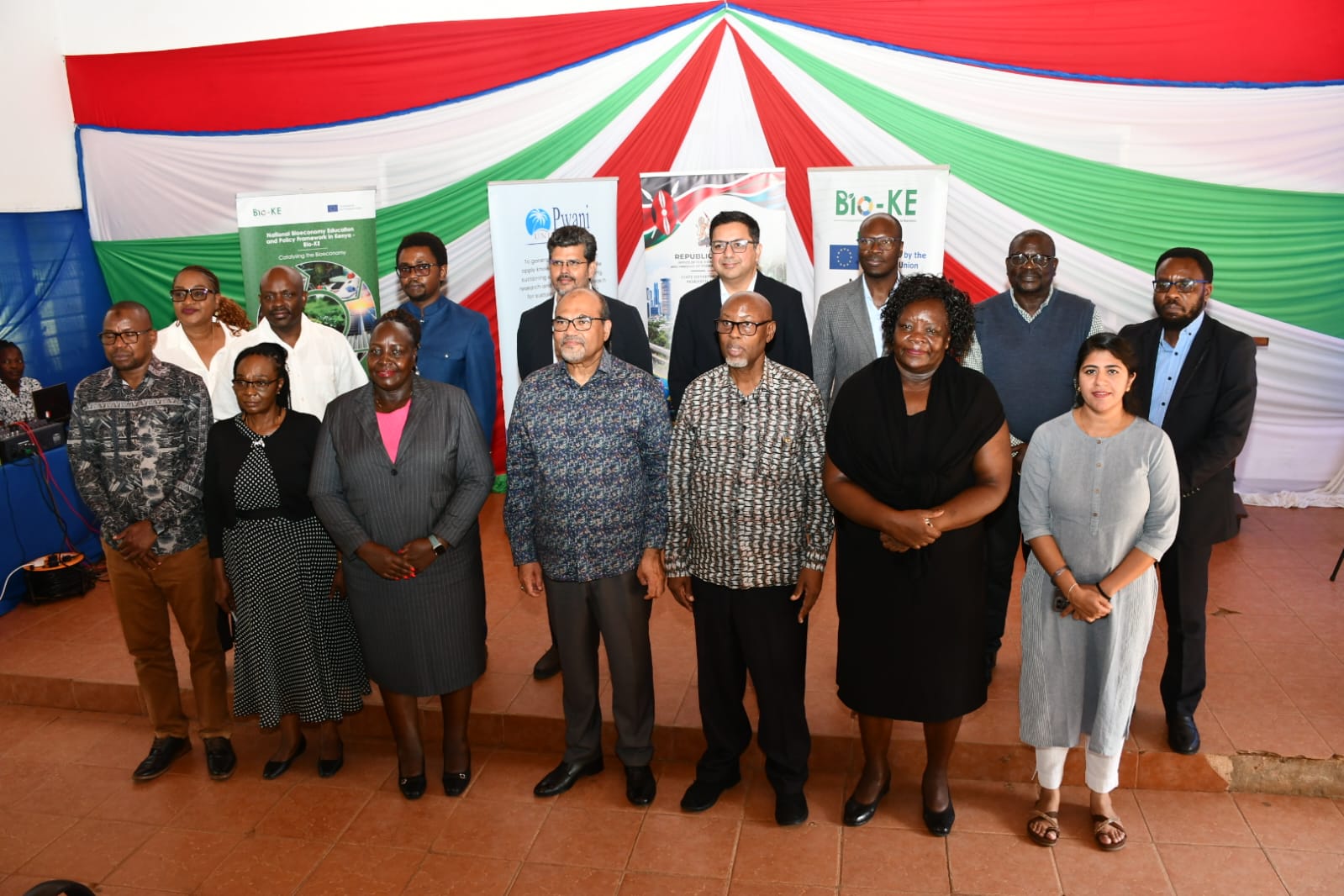
Kenya Moves to Unlock Bioeconomy Potential Through New National Strategy
Pwani University, Kilifi — Kenya is positioning its vast biological resources as a major driver of economic transformation, job creation and sustainable development through the National Bioeconomy Strategy.
Speaking during the National Bioeconomy Strategy Validation Writeshop at Pwani University, Principal Secretary, State Department for Science, Research and Innovation, Prof. Shaukat Abdulrazak, said Kenya must move beyond exporting biological resources in raw form and instead transform them into high-value products, technologies and services.
Prof. Abdulrazak said the bioeconomy represents a major opportunity for Kenya to create green industries, generate decent jobs, attract investment, strengthen food and nutrition security and increase the country's export potential.
“The time has come to change that story,” the PS said, noting that Kenya has for decades been endowed with rich agricultural lands, forests, rangelands, oceans and lakes, biodiversity, microorganisms and indigenous knowledge.
He said the country must harness these resources through science, research, innovation and technology to create greater economic value.
Strategy to drive coordination and investment
The PS said the National Bioeconomy Strategy provides an integrated framework bringing together agriculture, health, forestry, fisheries, manufacturing, environment, education, research, finance and industry.
The Strategy is aligned with Kenya Vision 2030 and the Bottom-Up Economic Transformation Agenda (BETA), as well as the country's commitments on climate resilience, food security, industrialisation and sustainable development.
Prof. Abdulrazak emphasized that the Strategy complements existing sectoral policies by providing a common platform for coordination, innovation and investment.
He said the success of Kenya's bioeconomy will depend on stronger collaboration between Government, academia, industry, communities, development partners and the private sector.
“Government cannot do this alone. Universities cannot do this alone. Industry cannot do this alone,” he said, calling for enduring partnerships to translate research and innovation into practical economic opportunities.
National Bioeconomy Institute proposed
A key proposal in the Strategy is the establishment of a National Bioeconomy Institute to serve as a national platform for coordinating bioeconomy research, policy support, technology transfer, commercialisation, investment promotion, capacity building and international cooperation.
According to Prof. Abdulrazak, the proposed Institute will help bridge the gap between research and the marketplace by connecting laboratories with industries, scientists with investors, universities with communities and innovation with enterprise.
“This will ensure that the Strategy moves beyond aspiration into implementation,” he said.
The PS further called for increased investment in research and development, accelerated technology transfer and commercialisation, greater support for young innovators and entrepreneurs, and increased private-sector investment in bio-based enterprises.
Pwani University commended
Prof. Abdulrazak commended Pwani University for its leadership as the Technical Lead of the National Bioeconomy Strategy Working Group.
He said the University's role demonstrated how institutions of higher learning can contribute beyond teaching and research to national policy development, innovation and economic transformation.
The PS also acknowledged the contribution of the National Commission for Science, Technology and Innovation (NACOSTI), the Commission for University Education (CUE), Ministries, Departments and Agencies, County Governments, research institutions, industry, civil society, farmers, youth and innovators.
He also recognized the contribution of development and international partners supporting the development of the Strategy.
Positioning Kenya as a bioeconomy leader
Prof. Abdulrazak noted that the global economy is increasingly shifting towards bio-based manufacturing, biotechnology, precision agriculture, industrial bioprocessing, sustainable forestry, blue economy innovation and circular production systems.
He said Kenya must position itself to take advantage of these emerging opportunities rather than remain a consumer of technologies and finished products developed elsewhere.
“The future belongs to economies that innovate with nature—not against it. Kenya cannot afford to remain a spectator. We must become a leader,” he said.
The PS said the implementation of the Strategy should ultimately deliver tangible benefits to farmers, researchers, entrepreneurs, young people and communities while ensuring that Kenya's natural resources are sustainably managed.
He challenged stakeholders participating in the validation process to move from policy development to implementation.
“Today, therefore, we do more than validate a Strategy. We launch a national movement—a movement that will transform Kenya's abundant biological resources into sustainable industries,” he said.
The National Bioeconomy Strategy is expected to provide a coordinated national framework for unlocking the economic value of Kenya's biological resources while supporting environmental sustainability, innovation and inclusive economic growth.